
Organise technical operator responsibility
When responsibility is shared, every record needs a recognisable owner and a verifiable closure. HubDix maps these connections in technical operations – from the due date to the confirmed action.
Starting point
From the responsibility chart to the completed record
An organisation chart describes roles, not completed work. For every installation it must be clear who plans dates, who coordinates execution and who assesses the result. Deputies and escalation paths belong to this too.
HubDix links maintenance, inspections and defects to sites and installations and notifies specific, responsible people when something falls due. Permissions limit who sees and edits what.
A permission in the system does not replace a legally effective delegation of duties. It makes the agreed responsibility visible in day-to-day work.
| Record | Notified |
|---|---|
| Maintenance, inspection | general manager and technical contact of the site |
| Defect | the responsible person, otherwise general manager and technical contact |
| Contract | contract owner and deputy |
| Approval | requester and responsible approvers |
| External assignment | its creator plus general manager and technical contact |
Unread notifications are also sent by email after 24 hours. Once a record is resolved, no further notifications are created.
The workflow
One workflow with four verifiable handovers
Each handover has its own state. A completed assignment is therefore not the same as an installation without defects.
Define the task
A qualified person determines the task, its basis and the interval.
Maintenance or inspection per asset typeDate and assignment
A named person schedules the date or assigns a company via a secure link.
External assignment with deadlineReview the result
The feedback with its report is confirmed internally – or rework is requested.
Confirm or request reworkSteer follow-up work
Open findings are deliberately created as defects with owner, deadline and, if needed, approval.
Defect register
In HubDix
Ownership stays visible on the record
The maintenance details show owners, external execution and the shared technical documentation in one place. What the company reports, what was confirmed internally and what is still open remain distinguishable.
- Responsibilities such as general manager or technical contact are separate from permissions
- Permissions are enforced on the server – filters and links never widen access
- A user who still owns open records can only be deactivated after a handover
- Histories on maintenance, inspections, contracts, approvals and external assignments
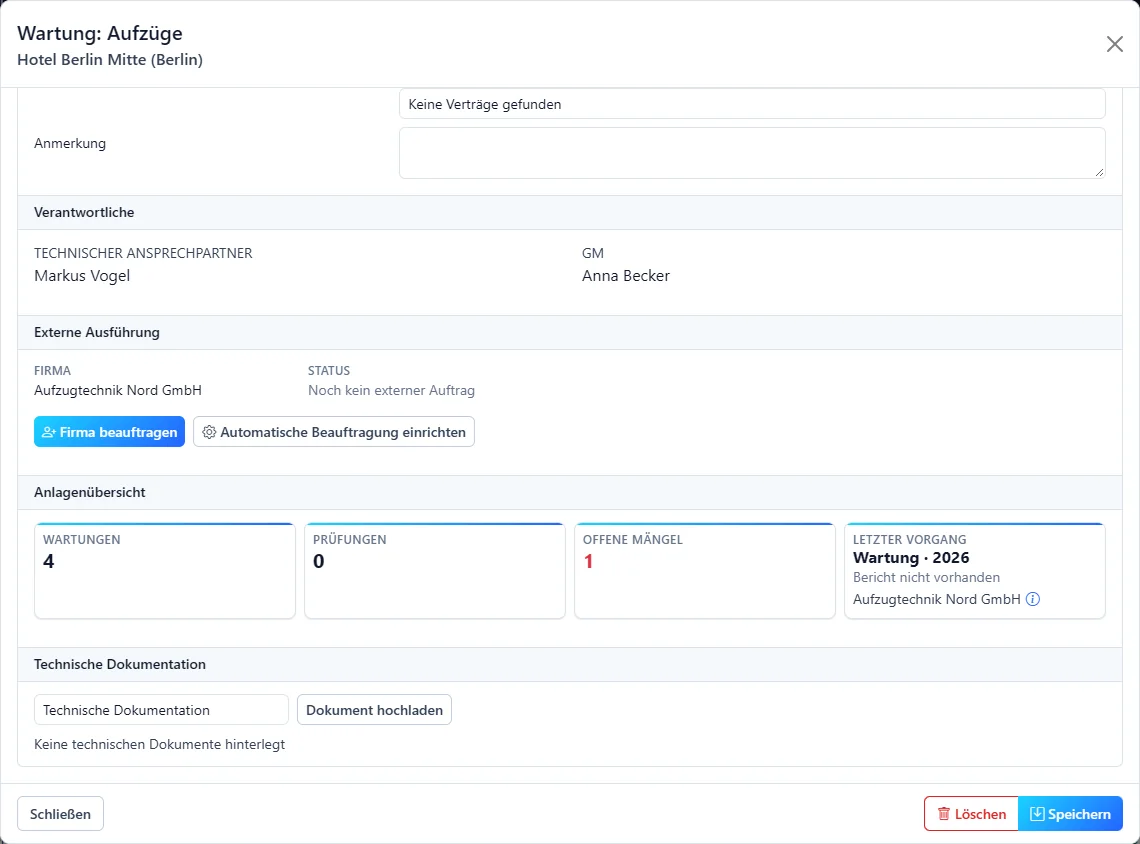
Fictitious example
Example: missing evidence after a contractor visit
A company reports the work as done, but the report is missing. A green schedule alone would not be sufficient evidence of the work.
- MondayCompany reports “done”The technical contact receives the notification “confirmation required”.
- TuesdayRework requestedThe report is missing. The company sees the reason through its link and reports again.
- ThursdayReport reviewedOnly now are outcome and finding assessed; the finding is created as a defect.
- AfterwardsConfirmedConfirmation closes the company's access. The defect continues with its own deadline.
For your rollout: test deviations like this at one site with a few installations – including when the responsible person is absent.
Framework
Have the legal framework determined by experts
HubDix supports organisation and documentation. It does not determine every operator duty automatically and does not guarantee legal compliance.
German legal basis, using the BetrSichV as an example
For work equipment within the scope of the German Industrial Safety Regulation, § 3 BetrSichV governs the risk assessment and the definition of required inspections. § 14 BetrSichV sets requirements for inspections and their records. Which rule applies to a specific installation must be assessed by a qualified person; other countries have their own rules.
Sources checked: 18 November 2026
What HubDix organises
- Due dates and notifications to owners
- Evidence on the record, not in an inbox
- Open actions with their own status
What stays with you
- Identifying the applicable duties
- Legally effective delegation and qualification
- Expert assessment of results
FAQ
Operator responsibility with HubDix
Does the software replace an expert assessment?
No. Applicable duties, inspection scope, qualifications and intervals are determined by qualified people outside the software.
Where do unresolved findings remain visible?
Recorded defects have their own status and deadline. A response to an assignment does not replace handling them.
What happens when a responsible person leaves the organisation?
If a user is still general manager or technical contact, owner of an open defect, contract owner or project lead, HubDix requires a handover to suitable people before the account can be deactivated. Historical records stay unchanged.
Read on
Related resources
Features, practical guidance and templates on the topic.
See HubDix for yourself.
The demo is a complete instance with fictitious sites and data. For questions about your operation, your installations and your processes, write to us.
The demo is set up for hotels – features and handling are the same in every industry.