
Which strategy suits the installation?
Preventive means the measure is planned before damage forces it. When it falls due can follow three logics, which often complement each other in practice.
- Time-based
- Due after a fixed calendar interval, for example annually.
- Easy to plan, independent of use.
- Usage-based
- Due after operating hours, cycles or mileage.
- Needs reliable meter or usage data.
- Condition-based
- Due when observations or measurements indicate it.
- Requires regular checks and clear thresholds.
An interval is not an arbitrary number. Take manufacturer documentation, operating conditions and expert requirements into account. A heavily used installation may need different measures from a comparable one that rarely runs.
Build a workable maintenance schedule
A maintenance schedule only becomes executable when every row has a clearly identified installation, an understandable task and a responsible person. At a minimum it includes:
- Site and unique name of the installation
- A task worded so the team carrying it out understands the scope
- The interval and its basis (manufacturer, contract, expert decision)
- Responsible person and, where applicable, the contractor
- Last completion, next due date and where the evidence is kept
Allow time for access and coordination. A date without an available installation, spare parts or a responsible person is not yet an executable plan. Record deviations and decisions about replacement dates traceably.
Example: the filter of a ventilation system
The schedule includes a check according to the requirements defined for this installation. At three consecutive visits the team records heavy contamination and replaces the filter earlier than planned each time.
That is a reason to review the plan with an expert – not proof of a new universal interval. What matters is that the information exists at all: finding, measure and next action. A row saying “done” provides too little.
Improve the schedule based on results
Review regularly what the schedule has achieved in practice. Only compare data with the same meaning – a postponement is not the same as a failure.
- Which dates were postponed, and why?
- Which reports are still missing?
- Which findings recur on the same installation?
- Which actions resulting from findings are still open?
How HubDix handles recurring maintenance
In HubDix every maintenance item has an interval – eleven levels from six times a year to every ten years. The next due date is the last recorded maintenance plus one interval and is recalculated whenever a history entry is saved, changed or deleted. Each history entry holds the company, outcome, report and any resulting defects.
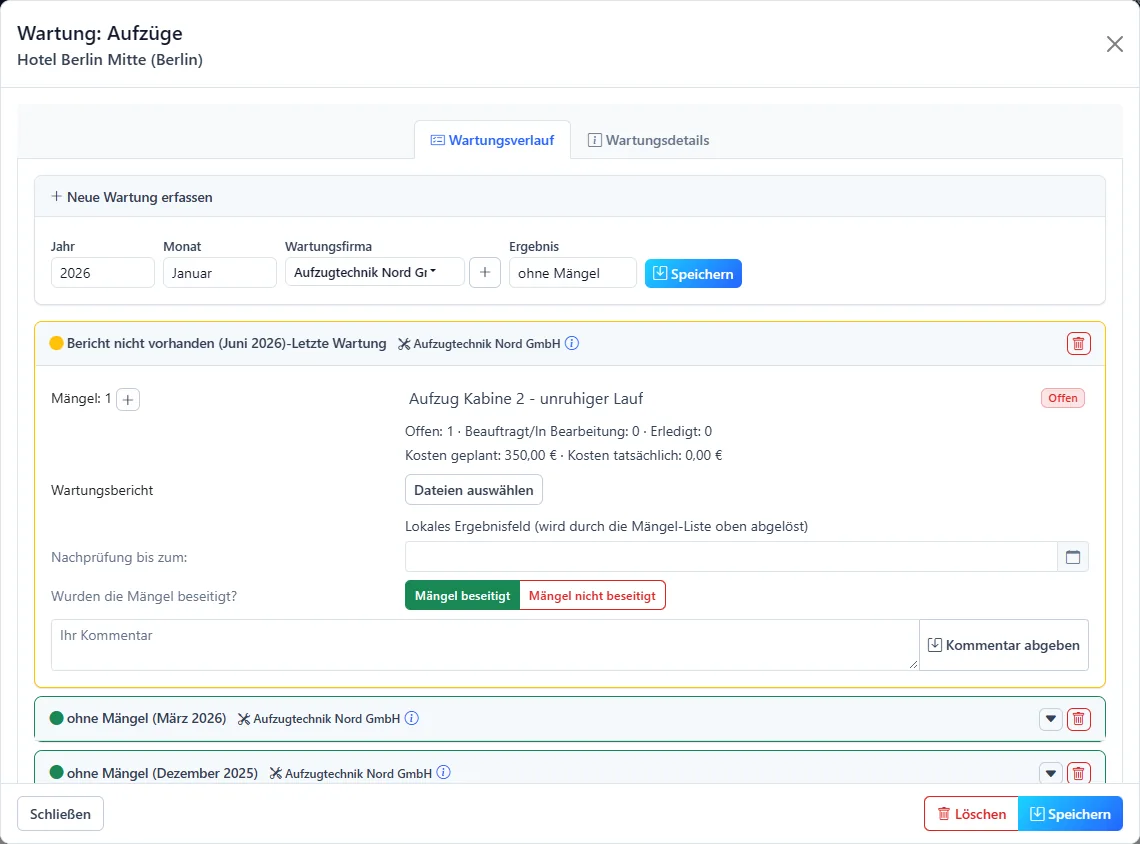
HubDix does not offer sensor-based failure prediction. Its value lies in findings and actions being findable on the record, so decisions about the schedule are based on documented cases.